Showing posts with label history. Show all posts

07 November 2012

For the Love of Saint Patrick (retreat day 1)

So, I'm a little behind on posting ... it's been a busy 10-ish days!

When I left you last, I was preparing to spend 4 days on retreat with my fellow YAVs. We had a great time! We began by heading from Belfast to Armagh, which is the seat for both the Catholic Church and the Church of Ireland. Both denominations have Cathedrals, both named St. Patrick's, in the city. Fun fact: this gives Armagh the honor of being the only city in the world with two cathedrals of the same name!

St. Patrick's Cathedral
(Church of Ireland)
Our first stop was St. Patrick's (Church of Ireland). We were welcomed by Rev. Grace Clunie from the Centre for Celtic Spirituality (an ecumenical mission project of the church), who gave us a tour of the Cathedral. We learned about the history of Armagh, as well as the church site - the hill where this church is located has been a holy site for over 1500 years. Originally a site for pre-christian tribal worship, St. Patrick founded his first stone church in Ireland here in 445.

Grace also taught us about Celtic spirituality, which draws its inspiration from the early prayers of the Celtic world. I could paraphrase the brochure, but since this is already looking like a post of epic length (even after breaking the retreat into several posts), I will direct those interested in learning more directly to the site for the Centre for Celtic Spirituality.
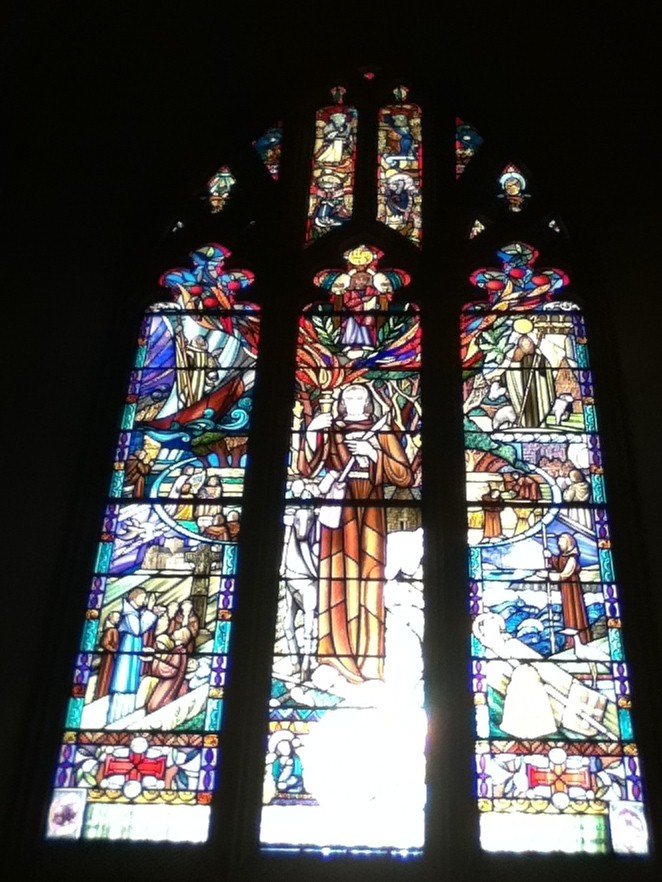
Stained glass featuring
Ferdomnach of Armagh
with Sts Brendan, Brigid,
Patrick and Columba 
After the tour, we spent some time in the practice of Celtic prayer, which focused on awareness of the sacred presence in this place. It was a great way to begin a retreat, especially one that would take place in such beautiful surroundings as the Mourne Mountains. We were even able to share the YAV tradition of Psalm 139.

I will include a few excerpts of our worship below:

Affirmation of Faith
I believe, O God, that you are the eternal Creator of life.
I believe, O Christ, that you are the eternal source of love.
I believe, O Holy Spirit, that your presence fills the universe.
I believe, O Holy Trinity, that you created my soul and formed all my days. Amen.
St. Patrick's (Catholic)

Final Prayers

Circle us Lord, keep light and love within, keep danger without. 
Circle us Lord, keep childlike trust within, keep fear without. 
Circle us Lord, keep health and peace within, keep dis-ease without. 
Deep peace of the quiet earth. Deep peace of the flowing air. 
Deep peace of the ocean's depth, deep peace of the God of peace. Amen.

After sharing a meal (and some great discussion) with Grace, we headed to ... St. Patrick's (Catholic).

We didn't get a formal tour here, so it was more of a self-guided affair. We spent our time here just soaking in the intricate mosaic work and gorgeous stained glass. There is something about a Catholic church that hits all your senses, and just walking through in silence was a profound experience.

This building was not as old as the Anglican cathedral, but also claims a link to Saint Patrick. The story of St. Patrick and the fawn ends at this spot, known as Tealach na Licci (Sandy Hill), which is considered a prophetic reference by the Saint to the second cathedral built in his name. I was glad for the opportunity to explore both of these historic cathedrals during our visit.

We left Armagh and headed to our rented house in Mayobridge, Co. Down. We took a moment for excitement over the presence of the elusive BATHTUB, and rooms were quickly assigned. We went for a walk before dinner, where a few of us realized our true potential as sheep-whisperers. I know you were worried that I might not get this on film, but never fear:


I know, you're impressed. 

We spent the rest of the evening in front of the fire, reading and playing card games. It was pretty much how we spent all free moments of the week (that we weren't sleeping), and pretty much exactly what I needed.

Anna and I were in charge of that night's Bible Study, so I leave you with this:

Benediction
Christ has no body now on earth but yours; Yours are the only hands with which he can do his work, Yours are the only feet with which he can go about the world, Yours are the only eyes through which his compassion can shine forth on a troubled world. Christ has no body now on earth but yours.
-Teresa of Avila

23 September 2012

Facing History

This has been a very full week, and I will do my best to synthesize all the thoughts running around in my head into one semi-coherent thought!

With Amanda at
TITANIC Belfast
First things first: last Tuesday, I had my first visitors! OK, so Amanda was really in Ireland to visit her family, but I was totally the beneficiary of this trip when they came to Belfast on my day off and I was able to go do "touristy" things with them. I was particularly excited to take the bus tour, hoping to receive new insights on the murals which Doug had only touched on in passing during orientation. As it turns out, Doug is such a fantastic tour guide that he gave us more information in passing throughout the city than the fellow whose job it is to provide this service! Hooray for Doug!

It was interesting, however, to see the murals through a different lens. I've begun to see how people can quickly categorize others around here, as the perspective of this nameless tour bus driver was quite different from those I've experienced... so my first thought was automatically, "I wonder if he grew up in a Nationalist neighborhood?"

On Wednesday, Anna, David and I went to an event hosted by David's placement site, the WAVE Trauma Centre (introduced here). As part of their week-long Autumn Seminar Series, they hosted a night exploring the use of comedy as a peace-building tool. It was an interesting insight into a coping mechanism of those living in Belfast at the height of the Troubles.

The following night, WAVE hosted a discussion of the film Judgment at Nuremburg as an example of their Facing History series. Clips from the video were shown interspersed with discussion about the psychiatry of compliance and conformity of the German population. Of course, for an Anthro/Soc nerd like me, it was a blast hearing Durkheim's collective consciousness discussed in casual conversation... but the heart of the conversation seemed to carry through my experiences for the rest of the week. Essentially about what it meant, both in Nazi Germany and Belfast at the height of the Troubles, to be an ordinary person in extraordinary circumstances, and individual complicity therein. How do we move past this to rebuild a healthy society?

On Friday, my coworkers from Fortwilliam and Macrory went to the old Crumlin Gaol (jail) for the unveiling of a report given for Bridge of Hope, a program of the local Ashton Community Trust, entitled Transitional Justice: Grassroots Engagement. I was intrigued by this model, exploring the place where conflict ends and rebuilding begins. Much like the discussion on Thursday night, there was a focus on the high costs related to the "survival skill" of moving forward from conflict without looking back and recognizing where you've been.

Transitional Justice launch
at Crumlin Gaol
The goal of this report was to look at the past and to have those difficult conversations, in an attempt to show the young people in their communities that they are committed to moving forward and ensuring a future that is peaceful and prosperous for future generations. 

The Transitional Justice model has five key pillars: 
  1. Truth-seeking and fact-finding
  2. Trials / criminal accountability
  3. Reparations
  4. Institutional reform
  5. Memorialization and collective memory
In essence, as a trust-building measure each party must be willing to listen to the other about their disparate experiences related to the same conflict. Different neighborhoods in Belfast have different experiences of the Troubles, which highlights a deep divide in this society. Much like the Judgement at Nuremburg film, it is important to face the truth of our past to help the survivors of this conflict, to recognize that harm has been done or trust has been broken, and to step up to the responsibilities of individual needs that arise from this. It is important to recognize where mistakes were made or systems were flawed in order to move forward efficiently, but it would be a disservice to those who have been affected by past injustices to move forward without recognizing the realities of this past.

The very location of the event was meaningful in that the jail is where many political prisoners were held during the Troubles until the building was decommissioned in 1996. For reference: the report states that 30,000 people spent time in prison due to the conflict. Many of these former prisoners have been internationally recognized as playing a positive and critical role in conflict transformation. A few of these were instrumental in this project, and in attendance at this event, which made me wonder what it would be like to go back in such a different time - facades repaired, cells repainted... completely whitewashed for public consumption.

    Original cells in unfinished side                                          Refurbished cells for public tours
      Dirty, peeling paint and general disrepair                      What a difference a fresh coat of paint makes!

In the spirit of looking back, next weekend is the 100th anniversary of the signing of the Ulster Covenant. This document essentially stated at the time that the undersigned would like to remain loyal to King George (and by extension remain a part of the United Kingdom), and is still very important to many people in this community. The key phrase included, however, is "...defending,... using all means which may be found necessary...", which has been used by some as a rallying cry for violence. With this important anniversary approaching, as well as the recent uproar over parades, much of the city is bracing itself for potential unrest to occur over the next few weeks. It remains to be seen whether this concern will be valid. 

I realize that this post has expanded to record length, so I will leave you with words from my supervisor at Fortwilliam & Macrory, the imitable Reverend Lesley Carroll:

"In the short-term we face a parade on September 29th with the potential to have civil unrest around it. In the longer-term we face the challenge of how to live with each other even after all these years. We face the challenge of how to let each other off hooks, how to do things that will help the other side to trust us and step out on new roads of relationship. We face the challenge of building and not tearing down, of offering hope to young people who as things stand right now don’t even have the hope of a job, at least not many of them. We face the challenge of working out what mutual respect actually means and looks like in society. We face the challenge of what to do about the truths yet to be revealed and we kid ourselves that a good dose of some truths will put things back the way they should be with the good people looking after the governance and the bad people either shamed or in jail. It simply won’t work. In the longer-term there is much to be faced."

(I encourage you to visit this page and read the rest of her post on transitional justice.)


29 August 2012

Getting real

Sorry you're getting these posts a little late, 
but I have a lot to process before I feel I can post these and really do them justice.

Today we started the days-long process of visiting everyone's sites. We started with my church, Fortwilliam and Macrory Presbyterian. The staff seems nice, and the building is gorgeous. I think I'll enjoy it there. We visit my community site, the Vine, on Friday.

After Fortwilliam and Macrory, we visited T.J.'s community site, the 174 Trust. It was very cool, and they treated us to a nice lunch. David's site, the WAVE Trauma Centre, was next. They were formed to work with those traumatized or bereaved by the Troubles in Northern Ireland, but have expanded their services somewhat since that time. It was our first real glimpse into the impact the Troubles have had on people's lives here.

We drove around the area to see some of the peace lines, famous in Belfast for their murals. The walls themselves separate unionist from nationalist neighborhoods, ensuring safety for those on the other side. The murals are used to show political loyalty, to express hope for the future, and memorialize events of the past or highlight perceived wrongs to members of the community.

This was followed by a trip to T.J.'s church, Woodvale Methodist, which is just off the Shankill Road, an area highly impacted by sectarian violence. His supervisor was very upfront with us about the troubles in the neighborhood, which began to make what we'd heard at WAVE feel much more 'real'.

We ended the day at the Bakers' house for dinner and a video taped from the BBC a few months ago about the Bloody Friday bombings in 1972. I've hesitated to post this video, but will include a link below for those interested in learning more. I will warn you that it can be quite emotional. Seeing the personal stories of these people really hit home the work that many of us would be doing in this area.


I know this may be new to many people back home. For those of you who might be worried for our safety, please don't. Doug has assured us that the most danger we're in here is to look the wrong way when we cross the street!

Fun fact of the day:
To add money to your pay-as-you-go phone is called "topping up".